
Building a biological understanding of ME/CFS
Myalgic encephalomyelitis (ME/CFS) is a debilitating multisystem disease with considerable variation in symptoms, severity and disease presentation. Despite its substantial impact on patients, there are currently no established diagnostic biomarkers that can reliably identify the disease or distinguish biologically meaningful groups of patients.
DISCOVER-ME brings together clinical characterisation, large-scale biological analysis and computational approaches to investigate the mechanisms underlying ME/CFS. The research is designed to connect detailed information about patients with biological evidence, allowing findings to be examined across different datasets, biological systems and patient populations.
The overall aim is to establish reproducible biological evidence that can contribute to improved diagnosis and prognosis, identify biologically meaningful patient subgroups and provide a stronger foundation for future therapeutic research.

Clinical phenotyping
A fundamental part of DISCOVER-ME is the detailed and harmonised clinical characterisation of people with ME/CFS.
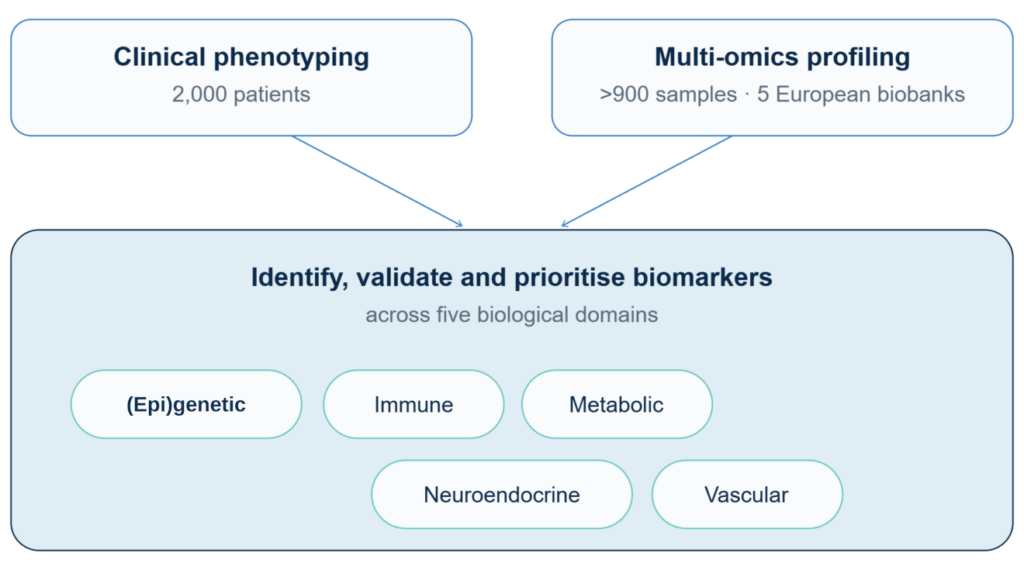
The project will collect harmonised clinical information from 2,000 patients, using refined and validated questionnaires to capture symptoms and other characteristics of the disease in a consistent way. Applying common approaches across the project will make it possible to compare clinical information between patients and investigate patterns within this large population.
This clinical phenotyping provides an important foundation for the biological research. By connecting biological measurements with detailed information about disease presentation, researchers can investigate whether particular biological findings are associated with differences between patients.

Biological characterisation and multi-omics
DISCOVER-ME will undertake extensive biological analysis using samples already available through major European biobanks.
More than 900 samples from five European biobanks (Austria, Iceland, Netherlands, Spain and UK) will undergo multi-omics profiling. These include samples from more than 700 people with ME/CFS and nearly 200 controls.
The research will investigate biomarkers across five biological domains:
(epi)genetic · immune · metabolic · neuroendocrine · vascular
The analyses will examine multiple layers of biology, including epigenetic patterns and proteins, alongside aspects of immune function, metabolism, hormonal regulation, vascular and mitochondrial function.
Rather than examining these systems independently, DISCOVER-ME will integrate information across the different biological domains. This systems-level approach is intended to reveal relationships that may not be apparent when individual biological processes are studied in isolation.
Biomarker discovery and validation
Identifying a biological difference is only the beginning. For a potential biomarker to become scientifically and clinically useful, the finding must be reproducible and validated.
DISCOVER-ME therefore incorporates both biomarker discovery and validation. Potential biomarkers identified through the biological analyses will be evaluated and prioritised to determine which findings provide the strongest and most reproducible evidence.
Using samples and data from multiple European biobanks provides an important opportunity to test findings across different patient populations rather than relying on observations from a single cohort.
The objective is to develop a robust pipeline through which biological signals can move from initial discovery towards validated biomarkers with potential relevance to diagnosis, prognosis and patient stratification.

Biologically defined patient subgroups
One of the major challenges in ME/CFS research is the substantial variation between patients. People diagnosed with ME/CFS can differ considerably in their symptoms and disease presentation, and this may reflect underlying biological differences.
DISCOVER-ME will investigate whether combinations of clinical and biological information can reveal biologically meaningful patient subgroups.
Data from clinical phenotyping and multi-omics analysis will be brought together and analysed using computational approaches, including AI-assisted stratification. Rather than grouping patients solely according to symptoms, the aim is to investigate whether subgroups can be grounded in biological mechanisms.
Developing a systems-level taxonomy based on disease mechanisms could help explain some of the heterogeneity seen in ME/CFS and provide a foundation for more precise approaches to diagnosis, prognosis and future treatment research.

Disease maps and digital twins
DISCOVER-ME will go beyond identifying individual biomarkers by investigating how biological mechanisms interact within the disease.
Research findings will contribute to open-access disease maps representing biological mechanisms and their relationships. These maps are intended to provide a systems-level representation of current knowledge and evidence generated by the project.
Computational modelling will then be used to develop digital twin models that integrate biological mechanisms with relevant social and economic determinants of health.
These models provide a way of exploring complex relationships computationally and testing hypotheses in silico. They can help researchers investigate how biological pathways may interact, explore differences between patient groups and examine potential therapeutic interventions before they progress to experimental or clinical investigation.

Precision drug repurposing
The biological understanding developed through DISCOVER-ME will also be used to investigate potential therapeutic opportunities.
Rather than beginning solely with the development of entirely new medicines, the project will use computational approaches to investigate whether existing active substances could influence biological mechanisms identified through the research.
More than 9,000 known active substances will be screened computationally, examining potential relationships between existing compounds and the disease mechanisms represented within the project’s computational models.
From this screening, promising candidates will be progressively prioritised, with approximately 20 to 50 substances expected to be selected for further research.
This does not mean that DISCOVER-ME is conducting clinical trials of these substances. The purpose is to identify and prioritise therapeutic hypotheses, considering discoveries about the biology of the disease alongside existing compounds that may act on relevant mechanisms, providing a stronger evidence base for subsequent experimental and clinical investigation.
9,000+
known active substances
screened computationally
prioritised
20–50
candidates selected
for further research
From research to clinical relevance
DISCOVER-ME is designed to connect biological discovery with questions that matter for the future clinical understanding of ME/CFS.
By combining harmonised clinical phenotyping, multi-omics analysis, biomarker discovery and validation, patient stratification and computational disease modelling, the project aims to build a more integrated understanding of the disease and the biological differences that may exist between patients.
Identification
Identifying biological mechanisms, signals, relationships and candidate biomarkers that may help explain ME/CFS.
Validation
Testing and comparing findings across datasets, cohorts, biobanks and complementary research approaches to establish which are robust and reproducible.
Prioritisation
Ranking validated biomarkers, patient subgroups and therapeutic hypotheses by the strength of their evidence and their potential clinical relevance, to focus further investigation.
Discovery
Bringing these steps together into new understanding of ME/CFS, including biologically defined patient subgroups and mechanisms that can inform diagnosis, prognosis and treatment.
Translation
Linking every step, and using validated findings to inform approaches with potential clinical relevance, including biomarkers, patient stratification and therapeutic investigation.
Validated biomarkers and biologically defined patient groups could provide a stronger basis for improved diagnosis and prognosis and help inform the design of future biomarker-guided clinical trials. Disease maps, digital twins and computational drug repurposing can also generate and prioritise therapeutic hypotheses for further investigation.
The longer-term objective is to help move ME/CFS research towards mechanism-based disease classification and more precise approaches to diagnosis, prognosis and treatment.
From identification to discovery
-
Identification
Finding candidate biological signals across five interconnected areas of research
-
Validation
Testing promising findings across independent cohorts, samples and biobanks
-
Prioritisation
Selecting the strongest candidates for further study
-
Discovery
Biologically defined patient subgroups and new understanding of ME/CFS
The connecting thread is translation, carrying findings forward from each step towards discovery
A Collaborative Research Programme
DISCOVER-ME brings together expertise from across Europe and beyond, combining biomedical research, clinical knowledge, data science and patient involvement.
Patient involvement forms part of the project throughout its lifetime, helping to ensure that research priorities, approaches and outcomes remain connected to the needs and experiences of people affected by ME/CFS.