
Work Packages
The work that makes discovery possible
DISCOVER-ME’s research is organised into ten work packages, each led by a different partner and focused on a distinct piece of the puzzle: from clinical case definitions and biomarker discovery, through disease mapping and modelling, to the social and economic impact of ME/CFS and the platforms and communication that carry the project’s findings forward. Together, they cover the full path from laboratory research to real world understanding.
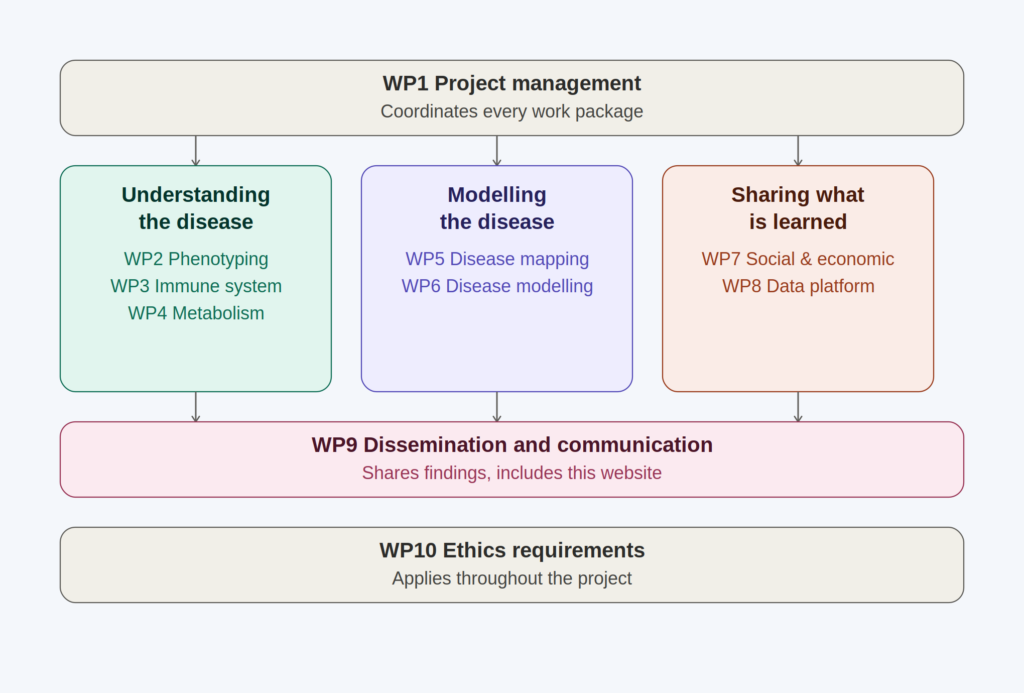
Project Management coordinates DISCOVER-ME across its 21 partners and 12 countries. This work package ensures the project runs smoothly from a scientific, administrative, legal and financial perspective, in line with Horizon Europe’s requirements. It covers day-to-day operational management, internal communication across the consortium, and decision-making processes. It also guides all partners in meeting the ethical and regulatory standards required for biomedical, clinical and data-related research, and maintains the project’s Data Management Plan to ensure research data is handled responsibly throughout. A dedicated quality assurance system tracks risks and keeps the project on course, while a coordinated approach to innovation management looks beyond the project’s own lifetime, to how its results can be exploited and protected for lasting benefit.
Months 1–48 (full project duration)
Clinical Phenotyping establishes harmonised, patient-informed clinical case definitions and stratification criteria for ME/CFS, so that patients across all participating countries are identified and grouped consistently. This work package identifies clinically meaningful patient subgroups based on symptom severity, disease duration, sex, age, coexisting conditions, and patients’ own reported experience. It guides the selection of well-defined and diverse patient samples from the project’s participating biobanks, and develops a clinical phenotyping tool that incorporates both symptom assessment and patient priorities. The work package also delivers a structured framework for translating these patient phenotypes into practical clinical use in future.
Immune System and Infection investigates pathogen exposure and immune related molecular and cellular biomarkers across clinically defined ME/CFS patient subgroups. The work package applies a careful three phase validation process: an initial discovery phase using UK samples, followed by longitudinal and technical validation, and finally external validation in four independent biobanks across Iceland, Austria, the Netherlands and Spain. Consistent quality control and standard operating procedures are applied across all analytical sites, ensuring that findings can be trusted and compared reliably. The most robust and reproducible biomarkers identified here feed directly into the project’s disease mapping and modelling work.
Duration: Months 1 to 36
Metabolism and Inflammation identifies metabolic, neuroendocrine, cardiovascular and inflammatory biomarkers linked to ME/CFS subtypes, using a wide ranging multi omics approach across each biological domain. As with the immune system work, this work package applies a rigorous three phase validation framework: an initial discovery phase using UK biobank samples, a stability analysis using longitudinal samples from the same cohort, and external validation across independent biobanks in Spain, Austria, Iceland and the Netherlands. Assay platforms, data models and sample handling procedures are harmonised across all participating laboratories, so that results remain comparable and reliable. The validated biomarkers identified here are prioritised for use in the project’s later disease mapping and modelling work.
Duration: Months 1 to 36
Disease Mapping and In Silico Simulations builds a comprehensive, computable map of ME/CFS, bringing together multi omics data and clinical phenotypes from across the project in a single, standardised framework. This work package performs an integrative analysis of the validated data generated earlier in the project, focusing on how different biological mechanisms converge and interact in ME/CFS. From this, the team generates and prioritises new, data driven hypotheses about what causes the disease and where treatment might have the greatest effect. The disease map also captures how ME/CFS varies and evolves over time, helping to explain why patients experience different trajectories and respond differently to care.
Duration: Months 1 to 43
Disease Modelling puts the hypotheses generated elsewhere in the project to the test, using both laboratory based (in vitro) and computational (in silico) approaches. This work package explores the causal pathways linking biological changes to ME/CFS symptoms across immune, metabolic, neuroendocrine and genomic systems, and works to validate candidate biomarkers as tools for prediction and patient stratification ahead of any future clinical use. A particular focus is the development of patient specific digital twin models, which combine biological and social science data to explore what personalised treatment strategies might look like. Findings from this work package feed back into the project’s disease map and help guide future translational research.
Months 1–48 (full project duration)
Social and Economic Disease Impact examines the personal, societal and health system burden of ME/CFS, using mixed methods research across different European contexts. This work package captures the everyday realities of living with ME/CFS, including its effect on education, employment, family life and access to care, and quantifies the economic costs involved at an individual, household and societal level. From this evidence, the team identifies unmet needs and develops practical recommendations for improving supportive care, shaping policy, and making health systems more responsive to people with ME/CFS. Social science and patient involvement perspectives are woven throughout, helping to interpret and contextualise the project’s biological and clinical findings.
Public deliverables:
-Report on the impact of ME/CFS on patients’ lives
-Economic burden and cost of illness report
-Extended digital patient needs survey dataset and report
-Identification and documentation of good policies
Months 1–48 (full project duration)
Data Sharing and Sustainability Platform designs and builds a secure data platform for the project, combining a central hub with partner hosted nodes so that research data can be shared and reused responsibly. This work package puts the FAIR principles (making data Findable, Accessible, Interoperable and Reusable) into practice, using recognised international standards and a searchable data catalogue. Strong privacy protection is built in from the start, including secure computation methods that allow data to be analysed without exposing it directly, alongside robust access controls and encryption. Automated quality checks ensure that data meets a consistent standard before it enters the platform. The work package also plans for the platform’s long term future, working towards integration with major European research infrastructures so that DISCOVER-ME’s data continues to benefit research beyond the project itself.
Months 1–48 (full project duration)
Dissemination, Exploitation and Communication raises awareness and understanding of ME/CFS research and the DISCOVER-ME project among patients, clinicians, researchers, policymakers and the wider public. This work package engages healthcare professionals and decision makers in evidence based dialogue, aiming to support meaningful policy change and improved care frameworks for people with ME/CFS. It works to maximise the uptake and reuse of the project’s results through targeted dissemination and open access publishing, and builds a sustainable exploitation strategy for the clinical tools, datasets and patient informed methods the project produces. This work package is also responsible for building and maintaining the DISCOVER-ME website itself.
Public deliverable:
Project website and digital communication platform (this website)
Months 1–48 (full project duration)
Ethics Requirements ensures the project complies with the ethical standards required of all Horizon Europe funded research, covering areas such as data protection, use of AI, and the involvement of human participants.
Duration: Months 1 to 36